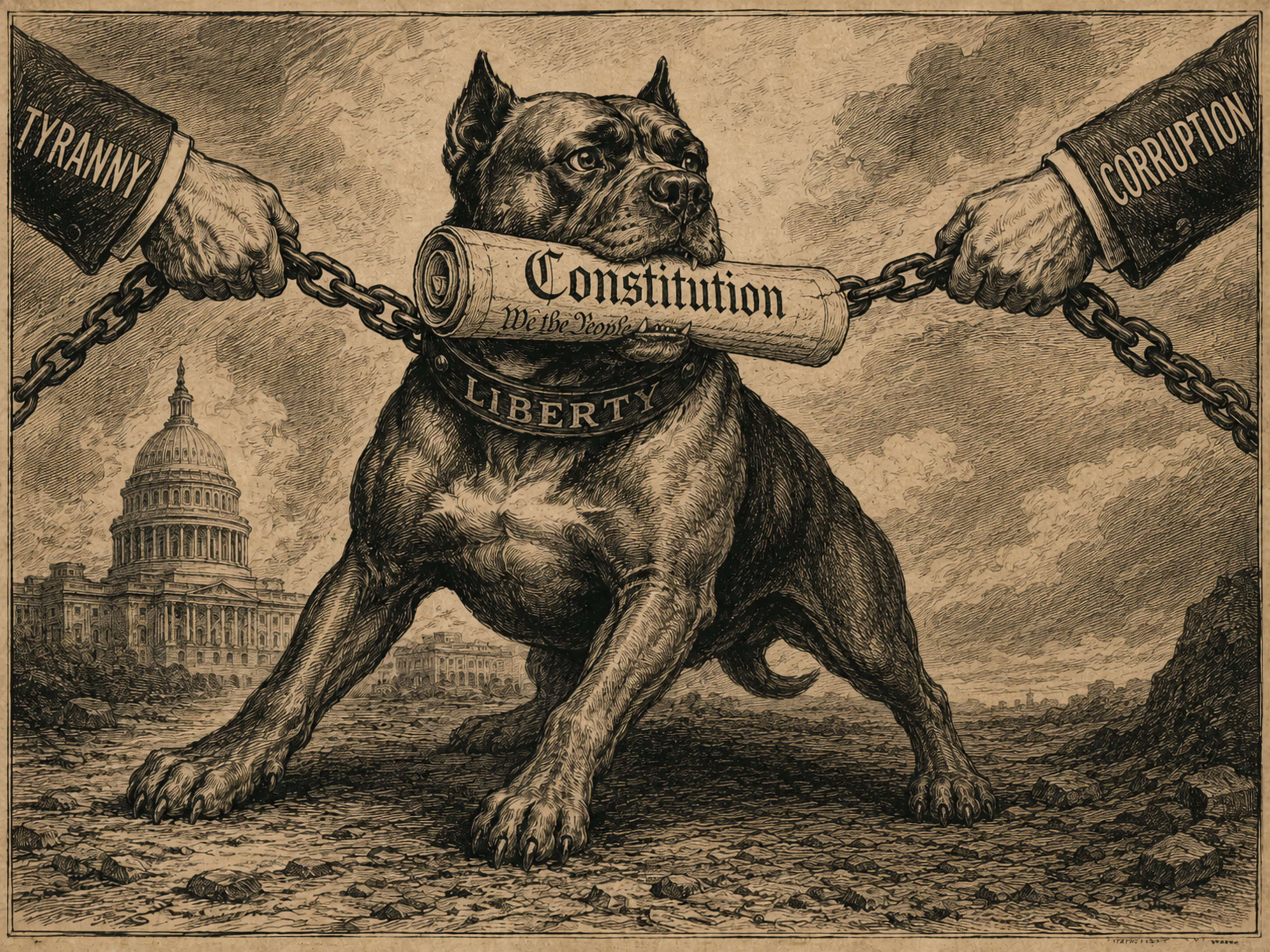
The common language that speaks of a “right to food,” a “right to housing,” a “right to health care,” and a “right to education” treats as self-evident what is, in fact, a confusion of categories. Human beings have needs. A person without water dies; a child deprived of education is placed at a lasting disadvantage. These are facts of the human condition. Turning such needs into rights, however, does not eliminate scarcity or the need for production; it merely shifts the burden. Someone must still grow, transport, process, and deliver, but when the State is presented as the guarantor of these rights, the labor of some becomes a permanent claim upon the labor of others, and everyone’s freedom is subordinated to a political promise of indefinite scope.
This confusion is not merely a matter of terminology. It is the starting point of a political conception that regards the citizen primarily as a beneficiary and the State as a provider, a conception incompatible with a proper understanding of fundamental rights.
A constitution may formulate freedom in two distinct ways: a) declare that the State grants it; or b) declare that the State recognizes a freedom that already belongs to the person. In the first case, the State places itself above the law; in the second, the law limits the State. Only the second model is consistent with the idea that freedom is not a concession.
The rights to life, physical integrity, freedom, property, conscience, expression, and association do not originate in a constituent assembly. They do not come into existence at the moment a document is promulgated, but belong to the person by virtue of their nature. The State may recognize, protect, or violate them, yet it cannot create or extinguish them by amending the legal text.
The order of things
The usual constitutional narrative proceeds as follows: the State drafts a constitution; the constitution enumerates rights; the citizen receives legal protection; the courts delimit the scope of those rights. The conception based on natural rights reverses the sequence. The person already possesses rights; political power is justified only under the limits imposed by those rights; the constitution records and formalizes those limits; State institutions have the function of protecting the person, including against the State itself.
When the State is treated as the source of rights, it simultaneously becomes author, interpreter, protector, and potential aggressor under the same rule. It writes the rule, decides its meaning, applies it, and even judges whether its own conduct has violated it. This is an excessively convenient arrangement for whoever holds coercive force.
The United States Declaration of Independence formulates the correct order: rights are inalienable, and governments are instituted to secure them; therefore, political power comes after rights, not the other way around.
Recognition and protection
The verbs employed in constitutional language are not immaterial, for to recognize a right is to acknowledge that it already exists. To respect it is to refrain from violating it; to protect it is to act against those who attack it; and the expression “guarantee,” in turn, tends to suggest that the State produces the right, controls its availability, or promises an outcome that no institution can make absolute.
No government is capable of guaranteeing that no person will be murdered. It can prohibit murder, maintain police and courts, punish aggressors, and limit the arbitrary conduct of its own agents, but these are duties of protection, not of creating the right to life.
Consider the situation of a person in a territory where no State institution is present. Another person attempts to enslave them. Do they have the right to resist? If freedom exists only because a constitution granted it, the answer becomes precarious, for the text, the police, and the judge are absent. If freedom is a prior right, the answer is clear: the attempt at enslavement is illegitimate regardless of any judicial pronouncement, and the right does not await the arrival of the State.
The absence of effective protection does not imply the nonexistence of the right, for a person may hold it even when, at a given moment, no institution is in a position to defend it.
The dangerous character of the State
The State is often described solely as a protector, but that description is incomplete because force is concentrated in it. It taxes, regulates, investigates, imprisons, confiscates property, controls borders, and commands armed forces. Even a legitimate State remains dangerous, precisely because the instruments necessary to protect the innocent can be used to oppress them.
Legal form constitutes one limit: public agents must act according to preexisting rules, defined powers, procedures, evidence, and review; moral limits constitute another: certain actions remain illegitimate even when internal procedure has been rigorously observed. Procedure does not turn slavery, torture, or political persecution into just acts merely because they were approved by a legislature in accordance with the formalities in force.
The language of concession
The Brazilian Constitution makes extensive use of the language of rights and guarantees. Article 5 protects life, freedom, equality, security, and property; Article 6, in turn, enumerates social rights, including education, health care, food, housing, transportation, and assistance. Constitutional doctrine generally does not claim that the State metaphysically creates life or human dignity; it interprets guarantees as legal mechanisms of protection. Even so, public language has effects.
When the State appears as the entity that “guarantees” rights, citizens tend to understand those rights as products of authority, and freedom ceases to be the person’s normal condition and comes to be seen as something granted. The State ceases to be bound by limits and comes to be perceived as a provider.
The observation that the courts would never interpret the text in this way does not resolve the difficulty, for they are themselves State institutions. Their restraint is valuable, but it cannot serve as the ultimate foundation of a right whose principal function is to limit the State itself.
A more precise formulation would be as follows: every person possesses rights inherent in life, freedom, physical integrity, conscience, expression, association, property, and self-determination. The State recognizes these rights, must not violate them, and must protect them against aggression. In this wording, the State does not deliver freedom to the citizen; it acknowledges a limit that already existed.
Needs and positive claims
The distinction becomes more delicate when food, water, education, medical care, and housing are introduced, for all are real human needs, and denying them would be absurd. A need, however, does not by itself identify the holder of the right, the obligated party, the quantity owed, the standard of quality, or the legitimate means of enforcement.
A negative right primarily imposes a duty of nonaggression. The right to life means that another may not kill; the right to freedom means that another may not enslave or arbitrarily imprison; the right to property means that another may not appropriate what belongs to someone without legitimate cause. These rights do not require a third party continually to produce a good for the holder; they require every person and institution to respect a limit.
Food, by contrast, requires production, for someone must prepare the land, plant, harvest, store, and transport; potable water supplied to a home requires collection, treatment, energy, and maintenance; education requires teachers, time, and continued labor. None of this diminishes the importance of these goods; it merely reveals the structure of the claim.
When it is said that every person has a right to a good that must be produced, the question immediately arises: who owes that production? If an individual farmer owes food merely because another person needs it, the farmer’s labor ceases to be entirely their own. If the obligation is collective, the State must define and impose it through taxation, regulation, debt, or some combination of these instruments, and the cost does not disappear merely because the word “State” is interposed between beneficiary and producer.
There is a clearer way to describe social provision. Food, water, education, and shelter may be recognized as fundamental needs; and a political community may decide that its State should organize a minimum level of access, just as it may fund schools, maintain water infrastructure, subsidize, or provide assistance. Workers continue to be paid; contracts are entered into; budgets are subject to deliberation. By political choice, the State has assumed a public duty, and that duty may be legally enforceable without needing to present itself as a natural claim against the labor of everyone else.
The distinction does not prohibit assistance policies; it does, however, make the discussion more honest, since, instead of claiming that the government creates the right to food, it recognizes that food is necessary and that the government has assumed a defined obligation to contribute to access to it. Instead of concealing the origin of the resources, taxation is identified; and instead of turning every desirable good into an unlimited claim, the policy is required to specify the content, scope, and cost of the promise.
A right whose holder, obligated party, quantity, standard, and limit remain undefined functions as a blank check, and the use of that word intensifies the conflict rather than clarifying it.
The cost of protecting negative rights
A frequent objection: courts, police, public registries, and penal institutions require resources. Therefore, negative rights also depend on positive provision, and that premise is correct; the usual conclusion, however, is not.
There is a difference between the content of a right and the institutional cost of protecting it, for the content of the right to life consists in the fact that another may not kill, while the justice system merely helps enforce that limit. The court does not become the source of the limit because its maintenance requires expenditure, and the same applies to the right to property, since protective institutions do not turn that right into a claim that the State must continually provide housing or income to every citizen.
Negative rights require institutions when society desires effective protection, but by their own logic they do not require the continuous delivery of a specific material good to the holder.
Legal language and public meaning
It may be objected that the word “guarantee” has a technical meaning: the Constitution does not create life or freedom, but creates enforceability, legal remedies, and institutional duties. This objection, however, is serious and deserves attention.
Legal terms often have narrower meanings than those of ordinary language. The Brazilian Constitution itself provides that the enumeration of the rights contained therein does not exclude others arising from its principles or from international treaties, and yet a constitution is not a text intended only for specialists, for it constitutes a public declaration about the relationship between the person and political power. Its verbs convey a conception: if recognition is what is intended, the text should speak of recognition. The citizen should not have to depend on doctrinal interpretation to know whether they are free by permission or by nature.
Interpretation and limits
No legal text applies itself, and interpretation is inevitable. Relativization, however, is not. The difference lies in whether interpretation preserves the rule or replaces it.
The right to freedom does not authorize the imprisonment of another; the right to property does not authorize poisoning a neighbor’s water; but resolving these cases does not require declaring that the right means whatever the State prefers at a given moment, but rather identifying the point at which one person’s action becomes an aggression against another.
A justifiable restriction must respond to a concrete threat to another’s right, be established by a prior and intelligible rule, be necessary and not merely convenient, employ the least invasive effective means, remain subject to independent review, and cease when its justification disappears. A generic invocation of the “common good” is insufficient, for every authoritarian government claims to act in the name of order, security, health, or equality. The burden of justification must remain upon those in power.
When the law abandons the right
Suppose that a constitutional amendment removes freedom of expression from the text, that the courts uphold the amendment, and that the police imprison critics under a formally valid law. Has the right disappeared?
Under strict legal positivism, domestic protection may have ceased; under the conception of natural rights, nevertheless, the State has not abolished the right, but placed itself in systematic violation of it. If the law creates the right, resistance is resistance to the very source of the right; but if the law merely recognizes it, resistance may constitute a defense of the right against a corrupted legal order.
The Universal Declaration of Human Rights and subsequent covenants brought civil liberties and social and economic claims together under the same designation. The word “right” was broadened to encompass distinct structures, and this expansion should be examined, not accepted as neutral.
A more precise constitutional arrangement
A constitution built upon the distinction defended here would comprise three levels: a) first, the recognition of inherent rights: life, freedom, integrity, conscience, expression, association, property, privacy, and self-determination precede the State, and public authority exists under these limits; b) second, duties of protection: the State must prevent, investigate, adjudicate, and redress aggression, while respecting due process and the same rights whose defense has been entrusted to it; c) third, defined public commitments: the State shall maintain programs established by law for basic education, access to potable water, emergency care, food assistance, and protection against extreme deprivation, within transparent fiscal rules and without turning any person into an unpaid provider.
Such a model does not require indifference to poverty, but it does require conceptual clarity. It refuses to present the government as the donor of freedom, to describe taxation as though the State produced resources independently, and to turn every need into an unlimited title over the labor of others. It nevertheless continues to allow schools, hospitals, water supply systems, and assistance programs. These institutions constitute political commitments created and administered through deliberation; they are not the source of the value of the human person.
The hierarchy
The State is not the source of the person, and the Constitution is not the source of human dignity, just as a court is not the source of freedom, nor a legislature the source of life. These institutions may recognize rights, protect them, interpret conflicts relating to them, and also betray them. Their power over legal remedies is real; their power over the moral existence of the right is not.
And the order must remain clear: the person comes first; the right derives from the nature of the person; the constitution recognizes the right; and the State is limited by the constitution and by the right that precedes it.
Food, water, education, medical care, and housing remain serious needs. A decent society must give them due attention, and the State may assume concrete duties to organize access to these goods. Such commitments must be defined, funded, limited, and subjected to public debate without fictions, but none of them requires the pretense that political power owns the rights it claims to distribute.
A government may remove a right from its laws, close the courts, imprison those who invoke it, and declare the violation legal, but it cannot make it just.